- Beliefs
-
Muslim Practices
- Salah (Daily Prayers)
- Sawm (Fasting)
- Hajj (Pilgramage to Makkah)
- Zakah (Charity Giving)
- Khums (Giving One-Fifth of Annual Saving)
- Jihad (Striving in the Way of God)
- Amr bil Ma'ruf (Encouraging Good)
- Nahy 'an al-Munkar (Stopping Evil)
- Tawalla (Loving the Prophet & His Family)
- Tabarra (Disassociating from the Enemies of the Prophet and His Family)
- Islamic Education
-
Akhlaq - (Ethics)
-
Quran & Sciences
-
Islamic History
-
Socio-Cultural
- Islamic Holy Places
-
Supplications
- Home
- Feature Selections ★
- Beliefs 🛐
-
Muslim Practices ☪️
- Salah (Daily Prayers)
- Sawm (Fasting)
- Hajj (Pilgramage to Makkah)
- Zakah (Charity Giving)
- Khums (Giving One-Fifth of Annual Saving)
- Jihad (Striving in the Way of God)
- Amr bil Ma'ruf (Encouraging Good)
- Nahy 'an al-Munkar (Stopping Evil)
- Tawalla (Loving the Prophet & His Family)
- Tabarra (Disassociating from the Enemies of the Prophet and His Family)
- Islamic Education
-
Akhlaq - Ethics 🔑
- Quran and Sciences 📖
-
Islamic History
- Socio-Cultural
- Islamic Holy Places
- eBooks
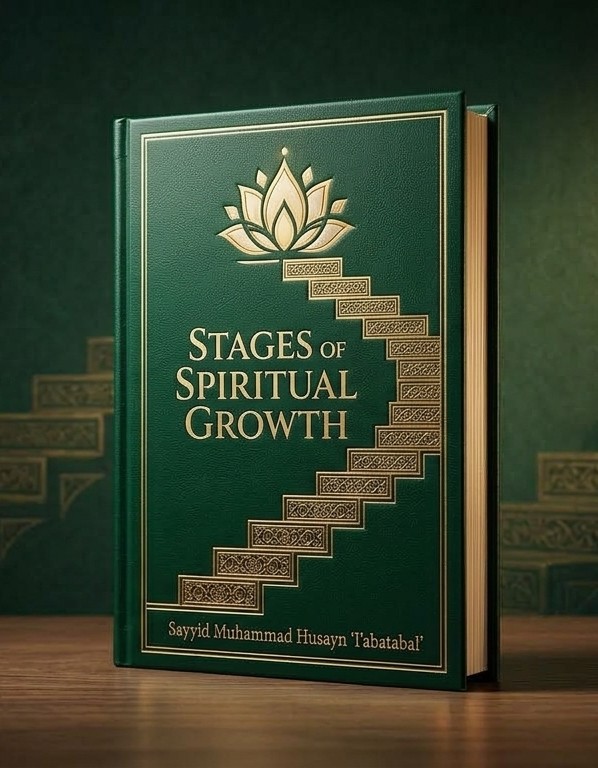
- STAGES OF SPIRITUAL GROWTH
STAGES OF SPIRITUAL GROWTH
Sayyid Muhammad Husayn Tabataba'i (d. 1981) is one of the
most distinguished Muslim scholars of recent times. Known by
the epithet "Allama' - which is a title used to denote a person who
has a profound understanding of many fields of knowledge - he
is remembered especially for his voluminous commentary on the
Holy Qur'an, al-Mizan ft Tajsir ai-Our'an. This present book is a
translation of the Kitab al-Insan of the 'Allama, a mystical and
theological work in which a concise exposition of the stages of
human creation is presented in three parts.
In Part 1, Man before the World, three realms of existence
are discussed: matter, imaginal form (mithiil), and intellect.
The existence of the realm of command ('iilam al-amr) and the
non-spatial and atemporal world of angels and human spirits are
also discussed.
In Part 2, Man in the World, real entities and mentally posited
entities are distinguished and a brief discussion on universal
guidance is also elucidated.